
Integration Scopes
Integration Scopes
Overview
Integration Scopes define the granular boundaries of data synchronization and webhook delivery between T-Gate and external applications. They establish a precise mapping that determines which specific data entities (brands, branches, and menus) should be synchronized with which external applications.
Core Concepts
Hierarchical Structure
Integration Scopes follow a hierarchical structure that maps the relationship between:
- Application Company: The connection between an external application and a company
- Brand: A restaurant brand within a company
- Brand Branch: A specific branch location of a brand
- Branch Menu: A menu assigned to a specific branch
Company
  └── Application Company (links Company to Application)
      └── Integration Scope
          ├── Brand
          ├── Brand Branch
          └── Branch Menu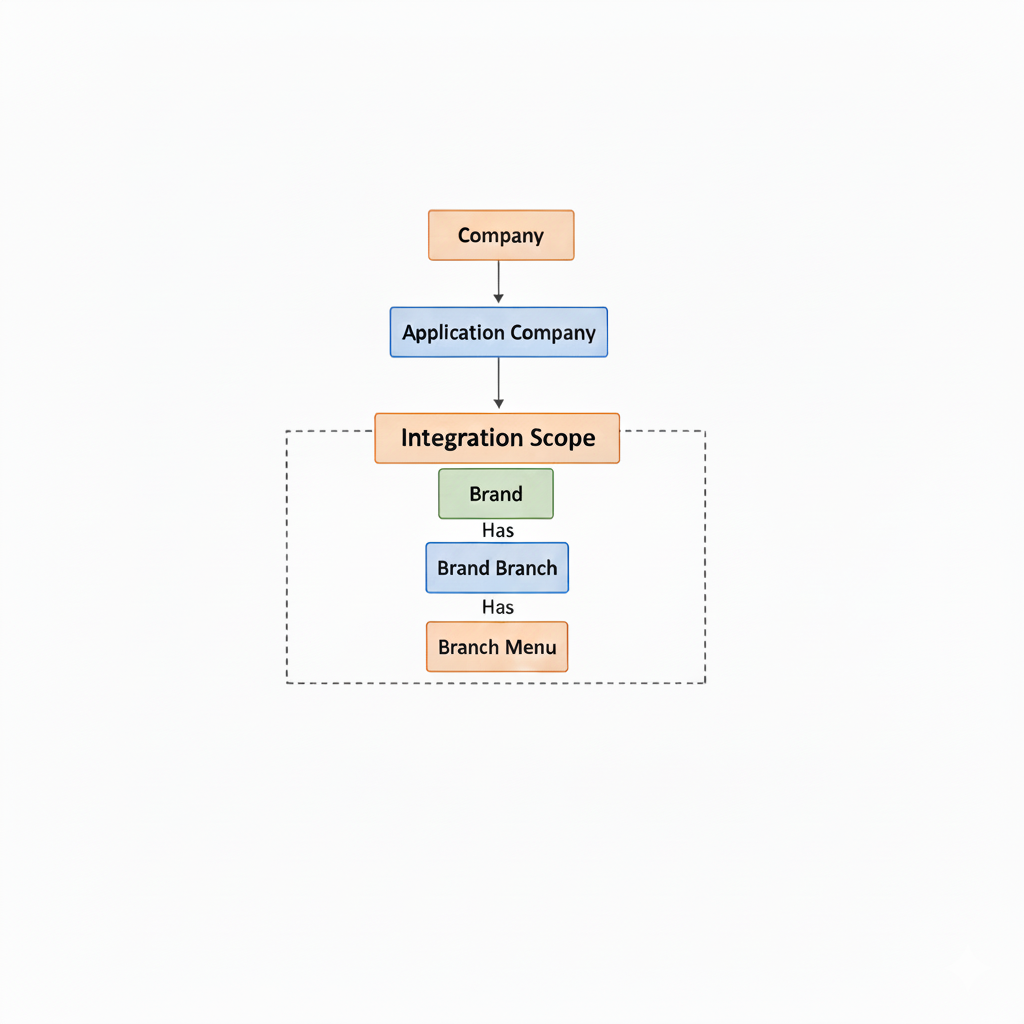
Key Relationships
Each Integration Scope uniquely identifies:
- Which application should receive data
- Which company owns the data
- Which brand the data belongs to
- Which branch location
- Which menu at that branch
How Integration Scopes Work
Data Synchronization
When T-Gate syncs data to an application:
-
It looks up Integration Scopes for that application
-
Determines which menus are allowed
-
Syncs only the scoped data:
- Sections
- Items
- Modifiers
- Prices
Anything outside the scope is ignored.
Webhook Delivery
Integration Scopes also control who receives webhooks.
What Happens on Data Change?
When something changes (menu, item, section, etc.):
- T-Gate finds related Integration Scopes
- Identifies affected applications
- Sends webhooks only to those applications
Example
If a menu item is updated:
- Only applications that have a scope including that menu will receive the webhook
Summary
Integration Scopes are the foundation of data synchronization and webhook delivery in T-Gate. They provide:
- Precise Control: Define exactly which data syncs to which application
- Scalability: Support complex multi-brand, multi-branch scenarios
- Flexibility: Allow different integration configurations per brand/branch/menu
- Reliability: Ensure data consistency through validation and constraints
- Automation: Automatically trigger webhooks when relevant data changes
Updated 10 months ago